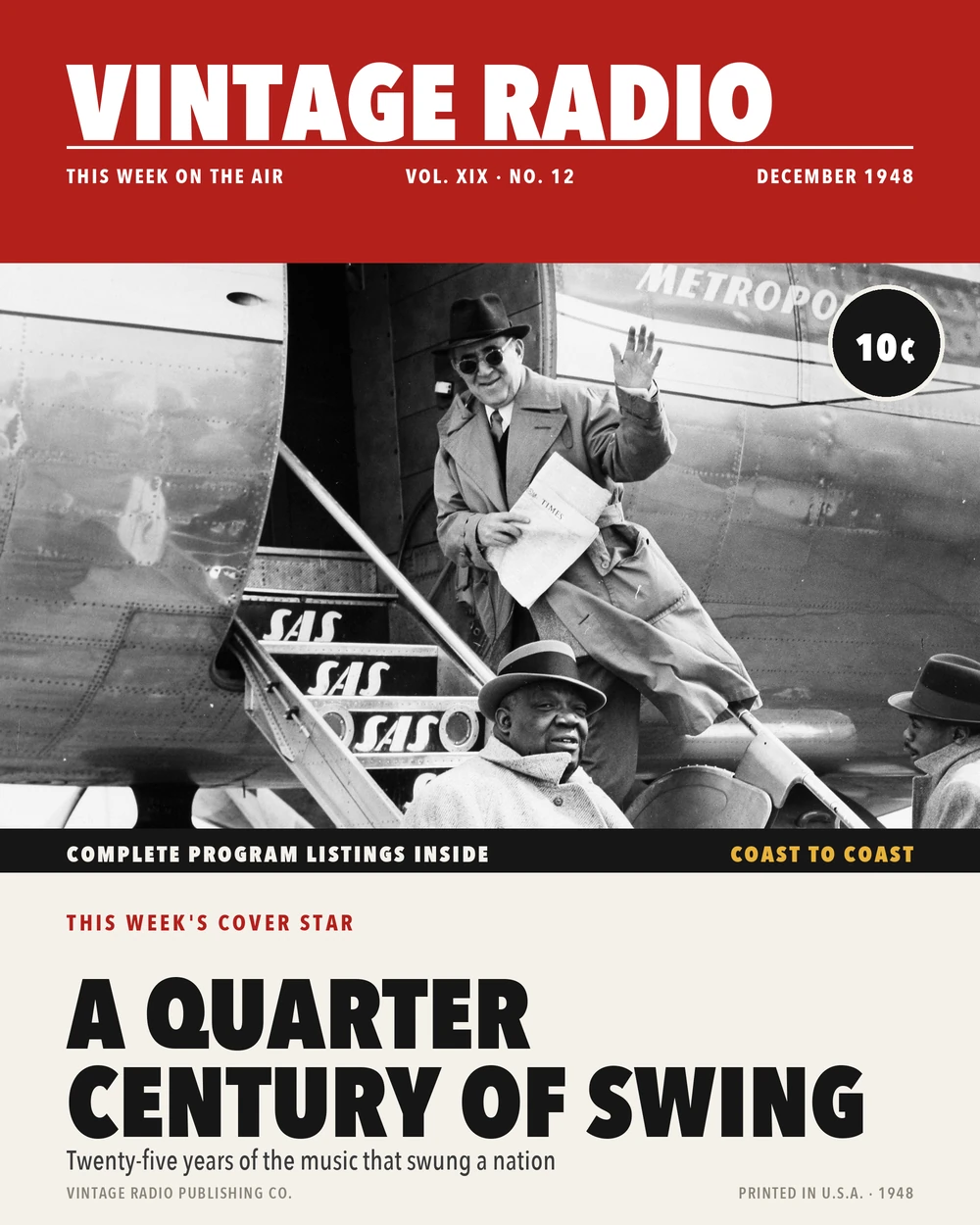
A Quarter Century of Swing
What It Was and Who It Was For
By the fall of 1964, the swing era was roughly three decades in the past, but the American Forces Radio and Television Service — AFRTS, the U.S. Department of Defense broadcasting arm that delivered radio and television programming to service members and their families stationed outside the continental United States — decided the music still deserved a dedicated showcase. A Quarter Century of Swing was the result: an anthology series devoted entirely to the big band sound, built around the artists and recordings that had defined American popular music from the early 1930s through the mid-1950s. It premiered on September 11, 1964, and ran through December 4, 1964, airing weekly on Thursdays.
The title was deliberate. Swing had developed in the United States in the late 1920s and early 1930s, grown into the country's dominant popular music by the mid-1930s, and held that position through roughly 1946. Twenty-five years of that arc made for a rich catalog to draw from, and the series was designed to cover it — the iconic figures, the bands, the stories behind the music. For the military audience it served, many of whom had grown up with this music or had parents who had, the show offered something familiar and personal at a considerable distance from home.
The Music and the Names Behind It
The series focused on swing as it had taken shape in the 1930s: lively, rhythmically driven, built for dancing, and distinctly different from the smoother jazz forms that preceded it. Benny Goodman — widely known as the "King of Swing," whose 1938 Carnegie Hall concert stands as one of the most discussed events in the music's history — is cited as one of the pivotal figures the show drew on. Duke Ellington, Tommy Dorsey, and Glenn Miller are similarly named as central to the series, and Ella Fitzgerald is among the musical luminaries featured or associated with the broadcast.
The format combined live performances, guest features, and behind-the-scenes accounts of the music scene — an approach that gave each episode some variety beyond simply playing records. The opening songs across the ten surviving episodes give a sense of the range the show worked with: an episode might open with "'Tain't What Cha Do," another with "American Patrol," another with "The Penny Whistle Blues" or "Up a Lazy River." The selections move between warhorses of the genre and less obvious choices, suggesting a programming sensibility that wasn't content to run through the same handful of standards every week.
At least one episode featured a genuinely contemporary act. The final surviving broadcast — Show 545, which aired December 4, 1964 — spotlighted the Si Zentner Orchestra, opening with "Up a Lazy River." Zentner was a trombonist and big band leader who had maintained a full-sized swing ensemble well into the 1960s, holding a Liberty Records contract from 1959 and recording swing-oriented albums through 1964 and beyond. His presence on the show indicated that A Quarter Century of Swing wasn't purely a retrospective exercise — it had room for bandleaders still actively working in the tradition at the time of broadcast.
The Numbers and What They Suggest
Ten episodes survive in the known catalog, with a combined running time of approximately four hours and eight minutes. Those episodes carry the numbers 485 through 545, and that detail is telling. A show whose surviving episodes are numbered in the 400s and 500s was almost certainly a long-running series with hundreds of installments — of which only this small cluster has been preserved. The gap in the surviving run is also worth noting: after Show 520, which aired October 30, 1964, the record jumps to Show 540 on November 27, with nothing confirmed in between. Whether those middle episodes are lost or simply haven't surfaced in known collections, the existing run is fragmentary.
The episode numbering also reframes what "a quarter century" means in the context of this particular broadcast. The title refers to the roughly 25-year arc of the swing era itself — not to the show's own run. By 1964, the series was old enough to have accumulated hundreds of episodes, yet it was still taking its name from music that had defined an earlier generation.
Related Programming and the AFRTS Context
AFRTS had a long history of packaging music programming for audiences geographically removed from the American commercial radio landscape, and A Quarter Century of Swing fit that mission: it brought a celebrated chapter of American music to listeners who had no access to stateside broadcasts. The show has been described as capturing something of the spirit of the era that produced the music — the years from the Great Depression through World War II — which had particular resonance for a military audience in 1964.
Among the related programs sometimes mentioned alongside the swing era, The Andrews Sisters Show — which ran on ABC and CBS from 1944 to 1951 — was a genuine swing-oriented radio presence, with the Andrews Sisters among the most prominent musical figures in wartime and postwar American broadcasting. The Bell Telephone Hour, a long-running concert series on NBC Radio from 1940 to 1958, is occasionally grouped with swing programming, though its focus was primarily classical and Broadway music rather than big band swing; Benny Goodman was among the popular performers who turned up on it from time to time, but it was never a swing showcase in the way A Quarter Century of Swing was.
What Survives
The ten surviving episodes represent a specific slice of the broadcast run — Thursdays from September 11 through December 4, 1964, with the November gap noted above. Each episode opens with a different piece: "A Very Special Day" for Show 485, "Enlisted Man's Mess" for 490, "A Thing Called Stomp" for 495, "Just One of Those Things" for 500, "American Patrol" for 505, "'Tain't What Cha Do" for 510, "The Penny Whistle Blues" for 515, "Flatbush Flanagan" for 520, "The Surrey with the Fringe on Top" for 540, and "Up a Lazy River" for the final show at 545. The variety across those opening tracks — some of them standard swing repertoire, others less immediately familiar — reflects a series working with a broad catalog over what was evidently a substantial run.
For a show produced specifically for service members abroad, A Quarter Century of Swing did something straightforward: it gathered the music of a particular era, brought in the people who had made it, and put the whole thing together in a format that could travel anywhere AFRTS could reach. The surviving episodes are what remain of a much larger production — a glimpse into a series that apparently ran for years and covered the swing era from multiple directions, one weekly hour at a time.